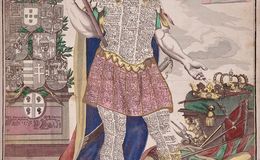
“Statua Regum Europaeorum P.C. N. Nomina Continen” (Colossal Kings) from 'Atlas Novus.Tabulae Geographicae’ by Matthaus Seutter the elder (1678-1757), Plate 2, 1728.
Statua Regum Europaeorum P.C.N Nomina Continens shows a king, flanked on one side by crowns, sceptres, weapons, musical instruments, etc, and on the other by coats of arms. On his body and armor are listed the kings of the different European nations from the first to the seventeenth century, with their star signs and dates of their death. To the left are twelve large armorials or coats-of-arms, with Germany at top.
This fascinating print elequently captures the ethic of the absolute monarchy that prevailed across Europe well into the 18th-century. The scene is dominated by the strong figure of a king, adorned with his crown and sceptre.
Allegorically, the scene is meant to show that all of the power, and indeed the political identity, of almost all European states was vested in one man; the Absolute Monarch. While Seuttter's depiction is original in style, it follows a long line of anthropomorphic portrayals of power as invested in the body of the king. Perhaps the earliest such representation is Sebastian Munster's 'Lady Europa' (1540); depicting Europe embodied by a Queen, representing the Spanish Empire. Another evocative image can be found on the frontispiece of Thomas Hobbes' Leviathan (1651), which was created by the 17th century French master engraver/etcher Abraham Bosse. The image figuratively depicts the powers of all of a kingdom's subjects being subsumed to form the the body of a great kingly power.