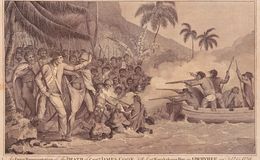
1.“An Exact Representation of the Death of Capt. Cook F. R. S. At Karakakooa Bay in Owhyhee on Feb. 14, 1779”, from Alex. Hogg.
To understand the initial warm welcome Captain Cook and his crew initially experienced upon arriving in Hawaii and the eventual hostilities that led to Cook’s death, it is useful to understand some of the Hawaiians sacred beliefs and customs. Lono is the Hawaiian god of agriculture and rain. The Hawaiians believed that he appeared in hoʻoilo (the wet season) along with rain clouds and winter storms. Traditionally Hawaiians described Lono as the “akua poʻo huna i ke ao lewa,” or the god whose head is hidden in the dark clouds. He believed that he played an important role in their agriculture by bringing rain, especially to the dry, leeward regions, which helped to keep the land fertile.
Legend has it that Lono is responsible for bringing cultivated plants to Hawaii. Lono also is associated with the makahiki celebration, which is a time of peace and recreation. It’s a time to celebrate the hard work of farming and enjoy the fruits of one’s labor. It was traditionally held that the Hawaiian god Lono had first appeared to the Hawaiians at the time of a makahiki celebration as a human. Before departing to "Kahiki", his home in the clouds, he promised to return as a man by sea with his great canoes ʻAuwaʻalalua”. Cook first arrived in Hawaii at Kealakekua Bay, near a large celebration to Lono during the Makahiki season in 1778. The sails and masts of Captain James Cook's ship resembled Lono’s legendary canoe, Akua Loa. The Hawaiians presumed that Cook represented the return of Lono.
Cook was treated with great respect and reverence. He was given gifts by the Hawaiian king and his men were treated like celebrities. However, after staying a month in Hawaii, Captain Cook was ready to resume his exploration of the Northwest coast of North America in search of the fabled Northwest passage, which was the official mission of this voyage. The British hoped that a transcontinental water route would enhance the British control of the continent by eliminating the need to make the long and arduous sail around the southern tip of South America. They felt this would give them an advantage in their war with the American colony, as well as greatly enhance trade.
Shortly after leaving Hawaii, Cook’s ships were caught in a great storm resulting in the loss of the foremast of Cook’s flag ship Resolution. The ships needed to return to Kealakekua Bay for repairs. This reversed the Hawaiians reverence for Cook, as he returned after the celebration for Lono had ended and with a broken mast and sail which they initially assumed meant that he was the reincarnation of Lono. They now realized that he was not a god, which subsequently led to an escalation of tensions and a number of quarrels between the Europeans and Hawaiians.
On February 14th at Kealakekua Bay, some Hawaiians stole one of Cook's small boats. Normally, as thefts were quite common in Tahiti and the other islands, Cook would have taken hostages and exchange them for the return of the stolen articles. Since the strategy had worked elsewhere, Cook’s men attempted to kidnap the king of Hawaii, Kalaniōpuu. The Hawaiians successfully resisted this and Cook's men had to retreat to the beach. As Cook turned his back to help launch the boats, he was struck on the head by the villagers and then stabbed to death as he fell on his face in the surf. Hawaiian tradition says that he was killed by a chief named Kalanimanokahoowaha. The Hawaiians dragged his body away. Four of Cook’s marines were also killed and two wounded in the confrontation.
The natives still held Cook in esteem, although not as a god. Cook’s body underwent funerary rituals similar to those reserved for the chiefs and highest elders of the society. The body was disembowelled, baked to facilitate removal of the flesh, and the bones were carefully cleaned for preservation as religious icons in a fashion somewhat reminiscent of the treatment of European saints in the Middle Ages. Some of Cook's remains were eventually returned to the British for a formal burial at sea following an appeal by the crew.
Captain Clerke, who had commanded the mission’s second ship, Discovery, took over the expedition and made a final attempt to pass through the Bering Strait. Following the death of Clerke, Resolution and Discovery returned home in October 1780 commanded by John Gore, a veteran of Cook's first voyage, and Captain James King. Cook's account of his third and final voyage was completed upon their return by King. David Samwell, who sailed with Cook on the Resolution, wrote of him: “He was a modest man, and rather bashful; of an agreeable lively conversation, sensible and intelligent. In temper he was somewhat hasty, but of a disposition the most friendly, benevolent and humane. His person was above six feet high: and, though a good looking man, he was plain both in dress and appearance. His face was full of expression: his nose extremely well shaped: his eyes which were small and of a brown cast, were quick and piercing; his eyebrows prominent, which gave his countenance altogether an air of austerity.” It was an unfortunate way for the life of this great explorer to have come to an end.
The Richard & Leslie Breiman Collection.