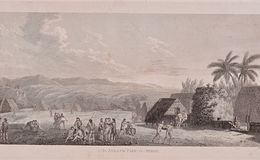
“View of A Morai or Burial Place in Sandwich Islands”: Captain Cook's first visit to Hawaii was on the island of Kauai (Atooi) from January 19-23 1778. Here he learned about the Hawaiians culture which included there approach to burying their dead. This engraving depicts a view of a moral or heiau (burial area) in the Waimea valley on Kauai, with a thatch-constructed long house on the left and an area enclosed by a stone wall with stones on the ground and carved boards marking graves, and an elevated structure constructed of branches lashed together in the background. Palm trees are present beyond the walls and mountains in the distance. On January 21, 1778, Cook reported: "The Pyramid which they call Henananoo was erected at one end [...] the four sides was built of small sticks and branches, in an open manner and the inside of the pyramid was hollow or open from bottom to top. Some part of it was, or had been covered with a very think light grey cloth, which seemed to be consecrated to religious and ceremonious purposes, as a good deal of it was about this Morai and I had some of it forced upon me at my first landing. On each side and near the Pyramid, stood erect some rude carved boards, exactly like those in the Morais at Otaheite. At the foot of these were square places, a little sunk below the common level and inclosed with stone, these we understood were graves. About the middle of the morai were three of these places in line, where we were told three chiefs had been buried; before them was another that was oblong, this they called Tanga[ta] taboo and gave us clearly to understand that three human sacrifices has been buried there, that is one at the burial of each chief."
The Richard & Leslie Breiman Collection.