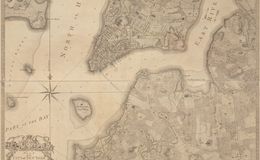
Washington knew that the British would have to return, and he reasoned that the most likely target would be New York City. As shown in this iconic map by British Lt. Bernard Ratzer, surveyed in 1767 and printed in 1776, the geography of New York was favorable for His Majesty’s Forces. At the bottom of the map, there is a magnificent view of what it was like to sail into the harbor in the late 18th Century. New York City was on Manhattan Island, and the network of the Hudson and East Rivers and New York Bay was easily controlled by the Royal Navy. The British could decide where and when to attack! Control of New York would separate the rebellious New England colonies from the Middle and Southern colonies. Further, New York with its population of 20,000 was second in size only to Philadelphia among cities in North America, and New York had many Loyalists.
Beginning in spring 1776, Washington began to move his army from Boston to New York and await the enemy. In late July, American hearts sank as they witnessed the British fleet sail into New York Bay. It had over 100 ships—the largest fleet ever sent to American waters—and carrying 30,000 British troops and German mercenaries. Washington’s army peaked at less than 20,000, but most were raw, unproved militia. Map surveyed by Bernard Ratzer in 1766 and 1767. Map engraved by Thomas Kitchin and published by Jefferys and Faden in 1776. / Image courtesy of The Miriam and Ira D. Wallach Division of Art, Prints and Photographs: Print Collection, The New York Public Library.
NYPL